
An ERP system is one of the largest investments a company makes in the way it runs – and one of the hardest to find concrete information about before deciding. This page collects what companies ask us most often. We are JRM Slovakia, the implementation and service partner for the QI information system, on the market since 1999.
What an ERP system is
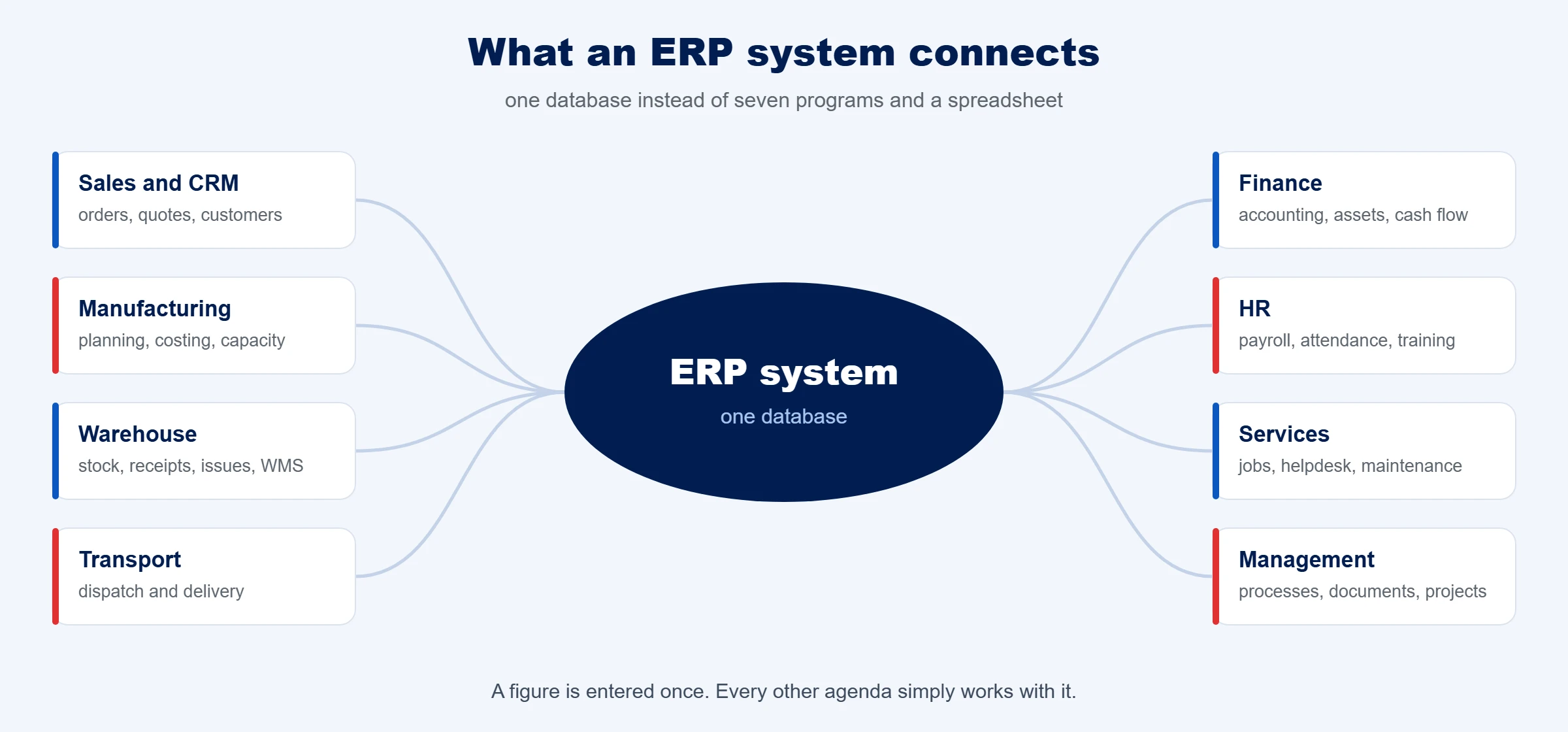
An ERP system (Enterprise Resource Planning) is a business information system that runs a company's key processes over one shared database. The order, production, the warehouse, transport, invoicing, accounting and payroll all work with the same data. A figure is entered once and everyone else simply uses it.
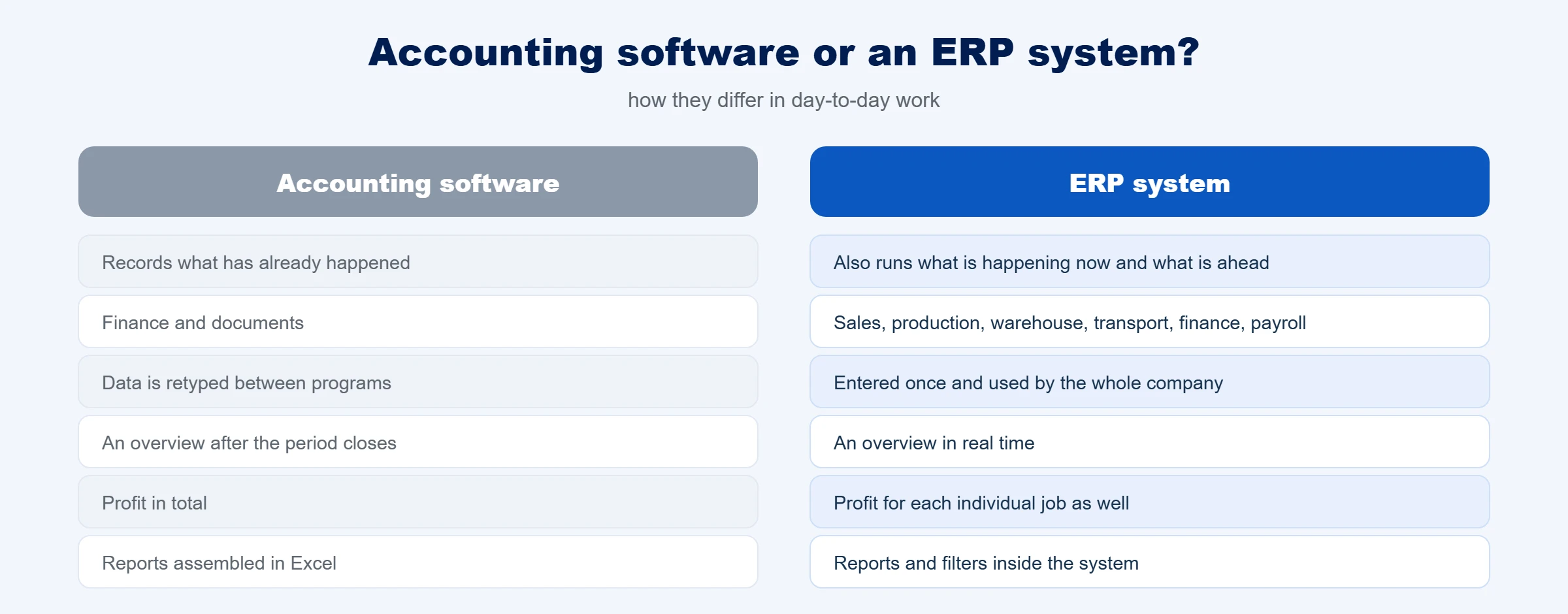
The difference from accounting software is fundamental. Accounting software records money – what has already happened. An ERP system runs the whole company, including what is happening now and what is still ahead: how much material to order, which job is late, whether a machine has free capacity, and how much the company actually earned on a particular sales case.
Companies without an ERP system usually run on a combination of accounting software, several spreadsheets and e-mail. That works until the company grows. Then the cracks start to show.
How to tell that a company needs an ERP system
We see these signs again and again. The more of them you recognise, the more an ERP system will do for you:
- the same data is retyped between several programs and spreadsheets,
- stock in the system does not match reality and every stocktake is a surprise,
- you learn about a late job after the deadline, not a week before,
- reports for management are assembled by hand in Excel, from scratch before every meeting,
- you cannot say how much the company earned on a particular job, only how much it earned in total,
- when a key person is away their work stops, because the information is in their head or on their computer,
- the company grows faster than the administration that serves it.
If you are not sure where exactly it hurts, take our ERP needs test. You answer yes, maybe or no to a series of questions covering twelve areas of a company, and at the end you get a profile showing where a system would help you most. It is free and without obligation; it is currently in Slovak.
What an ERP system is made of
A modern ERP system is not one large program but a set of modules. A company licenses only the ones it actually uses and can add more later. The QI information system has 31 modules in six groups:
- Company management – HR and attendance, organisation and management, processes and workflow, DMS, projects
- Sales and CRM – CRM and marketing, sales and purchasing, QI Shop, point of sale, warehouses and WMS
- Manufacturing – technical preparation and costing, production planning and APS, shop floor control, tooling, quality
- Services – service and maintenance, QI Helpdesk, property management, transport
- Finance – finance, payroll, assets, accounting, business intelligence
- QI Platform – QI Builder, system functions, e-communication, QI Portal, QI Mobile
Every module is described on the home page in the QI modules section.
An ERP system by type of company
ERP for manufacturing
In a manufacturing company the ERP system rests on technical preparation and costing: the bill of materials, the routing, the planned costing. Capacity planning and APS follow, then shop floor reporting straight from the production line and a comparison of planned costing against actual. The company sees work in progress online, material consumption, and which jobs are profitable and which are not. The KLARTEC case study describes what that looks like in practice.
ERP for trade and distribution
In trade, the warehouse and speed decide. The ERP system manages receipts, issues and the location of goods including WMS with scanners, price lists and commercial terms for individual customers, and connections to the e-shop and to carriers. A customer order runs all the way to the invoice without anyone retyping it.
ERP for services and projects
In companies that sell their people's work, what matters is work reporting, capacity planning and the profitability of each job. The daren & curtis case study describes how that changed an advertising agency: every job is on average 17 % more profitable than before the system was rolled out.
What an ERP system costs
The price of an ERP system cannot be quoted as a flat figure, because two companies of the same size may need a completely different scope. Four items make it up:
- licences – by the number of modules and the number of concurrent users,
- consultants' work – process analysis, configuration, migration of data from your old programs, custom development,
- user training – on your own data, not on a demo company,
- the service contract – legislative updates, handling requests, further development of the system.
On top of that comes hardware, either your own server or a rented one. You get the budget broken down item by item, so you know exactly what you are paying for.
The return is calculated where you lose money today: administrative time, errors in orders and invoicing, stock tied up unnecessarily, penalties for late deliveries and better production planning. We go through those numbers for your company during the analysis, before you decide.
How an ERP rollout works
Implementing an ERP system is not installing a program. It is a project with its own stages and its own deliverables:
- First meeting – we find out what the company is dealing with, what its processes are and what it expects from a system.
- Feasibility study – a description of your processes, the proposed solution, the scope of modules, an estimate of cost and time.
- Implementation plan – a document setting out what will happen: stages, dates and the people responsible on both sides.
- Rollout – installation and configuration, data migration, access rights, a trial run covering all main processes, training.
- Go-live – the start of live operation supervised by consultants, usually at the beginning of an accounting period.
- Customer care – a service contract, regular visits, further development of the system.
The article How a QI information system implementation works describes the whole process, including what each stage asks of you.
How to choose an ERP system
What decides an ERP choice is less the feature list and more these things:
- Fit with your processes. A system that forces you to change what already works will be an obstacle for its whole life.
- Changes that do not block upgrades. The QI Builder development environment is part of the system itself: added fields, documents and reports survive the move to a newer version.
- Scalability. The system has to handle the company you will be in five years, not only today's.
- Integrations. Banks, public registers, the e-shop, CAD/CAM, attendance systems, electronic invoicing and the Peppol network.
- The supplier, not just the software. Who will roll the system out, who will service it, and whether you will still know them after the contract is signed.
The QI ERP system
The QI information system is developed by QI group, a.s. It is a modular ERP system with more than 1 500 implementations in Slovakia and the Czech Republic. JRM Slovakia is its implementation and service partner: we run the process analysis, propose the set of modules, deploy the system, adapt it to your processes, train your people and look after QI after go-live.
QI handles electronic invoicing, including sending and receiving documents over the Peppol network, so it is ready for the mandatory e-invoicing being introduced across the EU.
You can see what the system looks like at customer sites in the videos from the companies we work with.
Frequently asked questions about ERP systems
What does ERP stand for?
ERP stands for Enterprise Resource Planning. It means a business information system that runs a company's key processes – sales, manufacturing, the warehouse, finance and HR – over a single database.
What is the difference between an ERP system and accounting software?
Accounting software records the finances, that is, what has already happened. An ERP system runs the whole company including manufacturing, the warehouse, jobs and planning, and accounting is only one part of it. Data is entered once and management has a running overview in real time.
How big does a company have to be for an ERP system to pay off?
The QI information system is used by small, medium and large companies. What decides is the complexity of the processes rather than the number of people: a company with twenty employees and make-to-order production gets more out of an ERP system than one with a hundred people and simple repeat sales.
How long does an ERP rollout take?
It depends on the scope. A company rolling out finance, warehousing and sales is usually live sooner than a manufacturer with planning and costing. You get a schedule with the dates of each stage right after the analysis. Go-live is usually planned for the start of an accounting period.
What happens to the data in our old system?
Master data – business partners, products, stock records and open documents – is migrated by automated import. For historical documents we decide together whether to migrate them or leave them available for reference in the old program. The migration is tested in a trial run before go-live and you check the data yourself.
Why do ERP implementations fail?
Usually for three reasons: the system is rolled out onto disorganised processes, nobody on the customer side has the authority to decide, and people are not trained. That is why we ask about processes first and configure the system second, run the project with one responsible person on each side, and train people on their own data.
Does an ERP system run in the cloud or on our own server?
QI can run on your own server or on a rented one. Which is better for you depends on the number of users and your IT infrastructure, and we go through that together. The data is yours either way, and access rights are set in detail.
Does an ERP system handle payroll and attendance?
Yes. The Payroll module handles the payroll agenda including statutory reports, and the HR and attendance module keeps records of employees, employment relationships, attendance, training and the validity of certificates. The data is shared with the other modules, so hours worked feed into job costing.
Let us go through it for your company
Write to us or call +421 33 535 4400. The meeting is without obligation – we go through what slows your company down most and say plainly whether an ERP system is the answer.
You can also read the frequently asked questions or the articles on our blog.