
From 1 January 2027, every VAT payer in Slovakia will issue and receive invoices only in a structured electronic form. A PDF invoice sent by e-mail will no longer be enough for domestic trade. This article explains what the change means for a company, how e-invoicing works in the QI information system and what to prepare. If you trade with Slovak partners, it concerns you as well.
This article is an overview based on publicly available information as of September 2026 and concerns Slovak legislation. It does not replace tax advice. What is binding is the current wording of the law and the guidance of the Slovak Financial Administration.
What an e-invoice is
An e-invoice is neither a scan nor a PDF. It is a structured data file in XML format following the European standard EN 16931 (Peppol BIS). The customer's information system can read it automatically, without anyone retyping the data.
Invoices will not be sent by e-mail but over the Peppol network. A company connects to the network through a certified provider, a so-called digital postman. The provider delivers the invoice to the customer and at the same time reports selected data from it to the tax authority.
Who the obligation applies to
- Domestic VAT payers. The obligation covers invoices in domestic trade between VAT payers (B2B) as well as trade with the state (B2G).
- Both issued and received invoices. A company has to be able not only to issue e-invoices but also to receive and process them.
- Non-VAT payers. Sole traders and companies that are not VAT payers do not yet have to issue e-invoices. If they receive invoices from a VAT payer, however, they must be able to accept them as e-invoices. That is why non-VAT payers also need an account with a digital postman.
Key dates
- 19 December 2025 – Act No. 385/2025 Coll. was published, amending the Slovak VAT Act and introducing electronic invoicing.
- 1 January 2027 – mandatory e-invoicing and digital reporting of data begin for domestic trade.
- 1 July 2030 – the obligation extends to cross-border trade within the EU.
The amendment also introduces penalties. According to the available summaries they can reach EUR 10,000 for a first breach and EUR 100,000 for a repeated one.
E-invoicing in QI
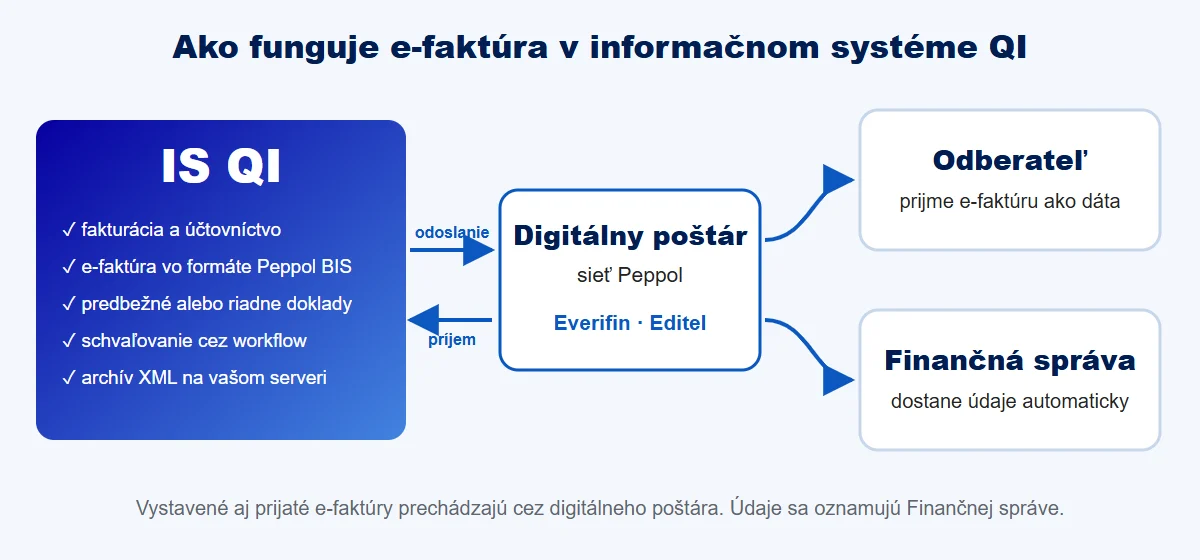
The QI information system keeps invoicing and accounting in one database, so the e-invoice is created directly in QI. The system sends it automatically to the customer through the digital postman and reports the data to the tax authority. QI already contains the E-communication module with tools for exchanging documents electronically with business partners.
Supported digital postmen
QI supports connecting to the Peppol network through these certified digital postmen:
Received e-invoices enter QI automatically
Incoming documents will enter QI automatically for our customers. That is why every company needs to adjust its processes. With each client we agree whether received e-invoices go into preliminary documents or straight into regular ones.
An approval process goes without saying. A received invoice can be sent for approval through the workflow that is part of QI, so it passes the right people before it is posted.
Archiving the XML files
Do not forget archiving either. An e-invoice is an XML file and it has to be kept. QI is ready to archive the XML files on your own servers.
Is your data ready for e-invoicing?
Before e-invoicing starts, prepare the following:
- Choose a postman. QI supports the digital postmen Everifin and Editel.
- Check your business partners' details. Verify the company and VAT identification numbers of both customers and suppliers.
- Sort out the process side with our consultant. Together we set how received invoices enter QI and who approves them.
- Archiving. It matters, so we are available to help with it.
- Testing and training. Before go-live we test everything and train the people who work with invoices.
Do not wait for December. Choosing a postman, checking the data and training all take time, and at the end of the year both suppliers and advisers will have their hands full.
Who will help you with e-invoicing in QI
E-invoicing in QI is handled by our consultants Marek Loj (marek.loj@jrm.sk) and Peter Oravec (peter.oravec@jrm.sk). They will help with configuring QI, connecting to a digital postman and adjusting the processes in your company.
Would you like to know what to prepare for the move to e-invoicing? Write to us through the form below or at info@jrm.sk, or call +421 335 354 400.
Related articles: Digitalisation in practice and What to consider when choosing an information system.