
A manufacturer needs something different from software than a trader or a service company. It has to know what a product is made of, what it actually cost and when it will be finished. Accounting software and spreadsheets cannot do that. The QI information system has five connected modules for manufacturing, and we have been deploying it in production companies since 1999.
What QI manufacturing software covers
Technical preparation and costing
Technical preparation is the foundation everything else rests on. In QI you keep bills of materials, including multi-level ones, and routings with operations, times and workstations, and out of them comes the planned costing. When a customer asks for a price, you do not guess it – the system builds it from material, labour and overhead.
Production planning and APS
Advanced planning takes account of machine and people capacity, job deadlines and material availability. You can run several scenarios and pick the one that meets the dates at the lowest cost. When a rush order arrives, you see immediately what it pushes back.
Shop floor control and reporting
Production orders are linked to the documentation and distributed to workstations. Operators report operations straight from the shop floor – through barcodes, touch terminals or a connection to an MES solution. Management sees work in progress online, not at the end of the month.
Tooling
Records of moulds, jigs and tools including where each one is, who has it and when its service life or inspection expires. Production does not stop because somebody is looking for a jig.
Quality
Incoming, in-process and final inspection, records of non-conformities and complaints with the cause traceable. When a complaint comes in, you know which batch of material and which shift the piece came from.
Why manufacturing software alone is not enough
The most common mistake when choosing is to buy a standalone production program and leave the old programs around it. Production then knows nothing about orders, the warehouse knows nothing about issues to production, and finance does not know what the job cost.
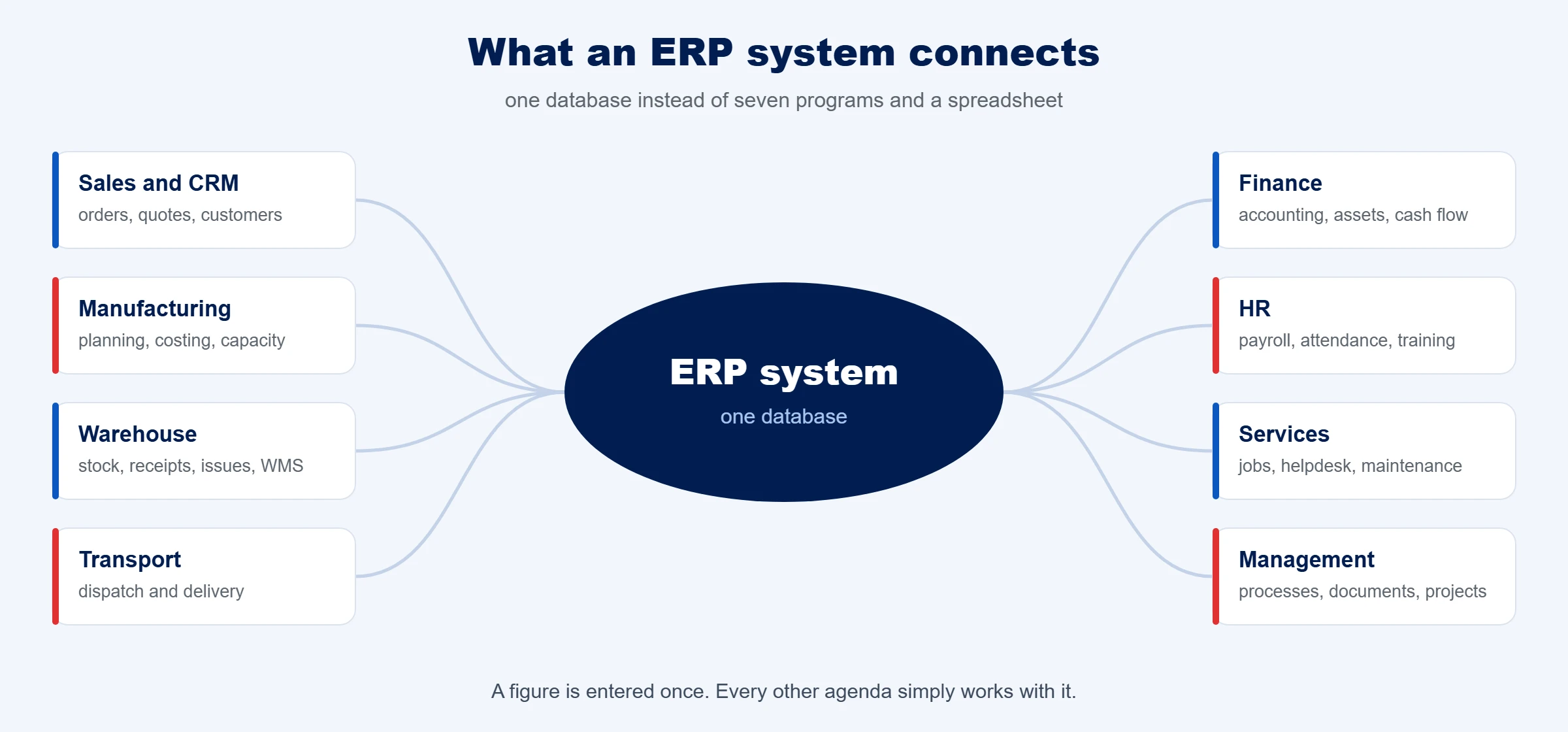
In QI, manufacturing is part of the whole. A customer order becomes a production order, issuing material writes the stock down, hours worked feed the costing, and the finished piece can be invoiced straight away. Data is entered once. That is why you can say at the end which job was profitable – a question most make-to-order companies cannot answer.
What it brought manufacturers
KLARTEC 15 %
A producer of precast concrete structures. 15 % less time spent daily across the company and almost €60,000 a year thanks to better transport organisation.
ADLO MES
A manufacturer of security doors. Operations reported straight from the shop floor, APS planning and a real view of every job.
Tichelmann video
A manufacturer talking about QI in their own words in a video reference.
The kinds of production QI suits
- Make to order – every piece different, costing and dates tailored to the job.
- Series and repeat production – batches, consumption standards, planning against call-offs.
- Assembly – multi-level bills of materials and purchasing against a job.
- Production with subcontracting – some operations at an external supplier, with the date and price tracked.
- Process and food production – batches, traceability and expiry dates.
Frequently asked questions about manufacturing software
What is the difference between manufacturing software, MES and ERP?
MES deals with what happens on the shop floor – reporting operations, collecting data from machines, the status of workstations. ERP runs the whole company including sales, the warehouse and finance, with manufacturing as one part of it. QI covers the ERP side and connects to MES solutions, so shop floor data feeds directly into costing and planning.
Can the software handle make-to-order production where every piece differs?
Yes, that is exactly what technical preparation is for. A bill of materials and a routing can be built for a particular job, the costing follows from them and the delivery date follows from the costing. Once the job is done you compare planned cost with actual and see where the estimate was wrong.
Do we need barcodes or terminals on the shop floor?
You do not have to, but it pays off. Without them reporting is manual and the data is less accurate. With terminals or scanners, management sees work in progress in real time and the operators have less paperwork. We set the scope to match how your production actually runs.
How long does a rollout take in a manufacturing company?
A manufacturer goes live later than a trading company, because bills of materials, routings and standards have to be prepared. You get a schedule with the dates of each stage right after the analysis. The article How a QI implementation works describes the whole process.
Can the software be adapted to our procedures?
Yes, through the QI Builder development environment, which is part of the system itself. Added fields, documents and reports survive the move to a newer version, so your changes will not block you at upgrade time.
What does manufacturing software cost?
The price depends on the number of modules, the number of concurrent users and the scope of the rollout. A manufacturer usually needs the warehouse, sales and finance alongside production. The breakdown is in our guide to ERP systems, and we prepare a specific quote after the analysis.
Let us look at your production
Write to us or call +421 33 535 4400. The meeting is without obligation – we look at how you plan, report and cost today, and say plainly what could be improved.
See also our guide to ERP systems, the ERP needs test or the frequently asked questions.